Heart Disease in Cats: Signs & What to Watch (Vet Verified)

Cats are experts at hiding how they feel. It’s a deeply ingrained survival instinct — and one that makes heart disease particularly difficult to catch early. By the time most owners notice any symptoms, the disease has often been progressing quietly for months.
Understanding what heart disease in cats looks like, what to watch for, and why early detection matters so much is one of the most important things you can do for your cat’s long-term health.
What Is Heart Disease In Cats?
Heart disease in cats is a common but often silent condition, affecting the heart’s ability to pump blood effectively. It most frequently presents as hypertrophic cardiomyopathy (HCM), where the heart muscle thickens over time. Signs of heart disease in cats can be subtle or absent until the disease is advanced, making regular monitoring and veterinary check-ups essential for early detection.
Key Takeaways
- Hypertrophic cardiomyopathy (HCM) is the most prevalent form, affecting cats of all breeds
- Many cats show no symptoms early on, making subtle behavioral changes especially significant
- Key warning signs include changes in breathing rate, reduced activity, and altered appetite
- Regular veterinary check-ups and continuous at-home monitoring are an effective combination for early detection
What Is Heart Disease in Cats, Explained
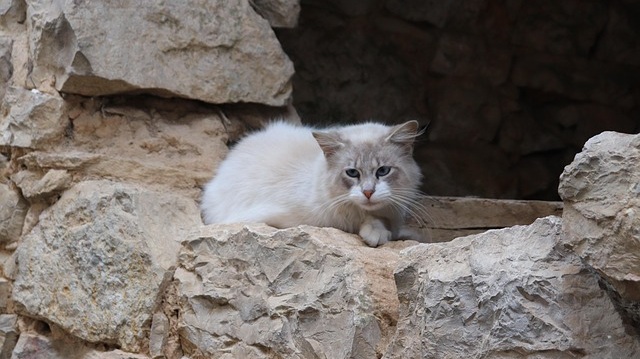
Heart disease in cats refers to a range of conditions that affect the structure or function of the heart, impairing its ability to circulate blood effectively throughout the body. It can be present from birth (congenital) or develop later in life (acquired).
Congenital heart disease involves structural abnormalities that arise during fetal development and may affect heart valves, interior walls, or the major blood vessels. Acquired heart disease, which is far more common, develops over a cat’s lifetime and is most frequently diagnosed in middle-aged to older cats — though it can occur at any age.
What Are the Most Common Types of Heart Disease in Cats?
Several types of heart disease affect cats, each involving different changes to the heart’s structure:
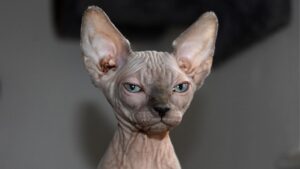
Hypertrophic Cardiomyopathy (HCM) is by far the most common, accounting for the vast majority of feline heart disease cases. The muscular walls of the left ventricle thicken progressively, reducing the heart’s ability to fill with blood and pump efficiently. According to VCA Hospitals, HCM has a strong genetic component and is more prevalent in certain breeds, including Maine Coons, Ragdolls, British Shorthairs, Sphynx, Bengals, and Persians — though no breed is immune.
Restrictive Cardiomyopathy (RCM) causes the heart muscle to become stiff and inelastic, restricting normal blood flow even if the walls themselves haven’t thickened significantly.
Dilated Cardiomyopathy (DCM) is now relatively rare in cats, largely due to widespread taurine supplementation in commercial cat foods. It involves enlargement and weakening of the heart chambers, leading to poor pumping function.
Unclassified cardiomyopathies represent cases that don’t fit neatly into the above categories and may share features of multiple types.
Heart disease can also develop secondarily to other conditions — most notably hyperthyroidism and hypertension — which is why managing these underlying diseases promptly is important for cardiac health.
“Every time Umi is hospitalized, it’s for like four days and it costs over $5,000… Maven has helped me not only save money but also save his life”
★★★★★
Jessica Ortiz
Umi
What Are the Signs of Heart Disease in Cats?
Many cats — particularly in the early stages — show no signs at all. When symptoms do appear, they are often gradual and easy to attribute to aging or stress.
Signs to watch for include:
- Reduced activity levels — less interest in play, reluctance to jump, or spending more time resting
- Increased withdrawal or hiding — behavioral changes that reflect fatigue or discomfort
- Reduced appetite or unexplained weight loss
- Increased resting respiratory rate — more than 30 breaths per minute during sleep or calm rest is a significant warning sign
- Labored or open-mouth breathing — any open-mouth breathing in a cat at rest is abnormal and requires urgent attention
- Weakness or sudden hind limb paralysis — a potential sign of aortic thromboembolism (ATE), a life-threatening complication requiring immediate emergency care
- Distended abdomen — may indicate fluid accumulation
It’s worth noting that coughing, which is a common sign of heart disease in dogs, is not typical in cats with cardiac disease. If your cat is coughing frequently, this is more likely to indicate a respiratory condition, such as asthma.
Why Is Heart Disease Hard to Detect in Cats?
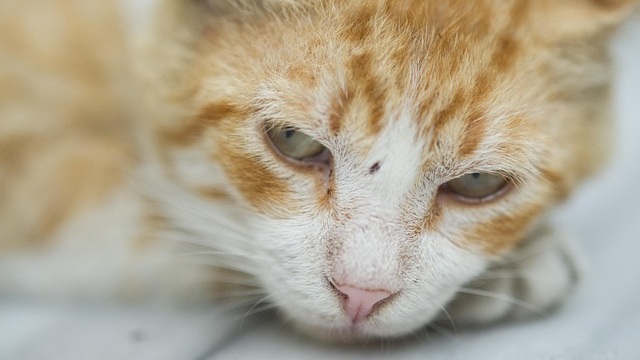
Several factors make feline heart disease uniquely difficult to catch early:
Early disease is often clinically silent. Many cats in the early stages of HCM have no detectable symptoms. A significant proportion have no heart murmur that can be detected by a stethoscope — meaning a routine physical exam may not raise any flags.
Stress affects diagnostic accuracy. Cats are notoriously reactive to the clinical environment. An elevated heart rate or abnormal breathing pattern at the vet may reflect stress rather than disease, and conversely, a calm cat at the clinic may not show the changes that appear at home.
The first visible sign can be a crisis. For some cats, the first indication of heart disease is a sudden acute event — an episode of respiratory distress, hind limb paralysis from a blood clot, or, in the most tragic cases, sudden death. This is why waiting for symptoms is not a reliable strategy.
“Heart disease in cats is often silent in its early stages. Subtle changes like increased resting respiratory rate or reduced activity can be the first indicators — which is why consistent monitoring is so important.” — Sara Leitão, DVM, Veterinarian at Maven Pet
When Should You Be Concerned?
Some signs require prompt veterinary attention, while others are worth monitoring closely and discussing at your next appointment.
Seek immediate veterinary care if your cat shows:
- Open-mouth breathing or visible respiratory distress
- Sudden weakness, pain, or paralysis in the hind legs
- Collapse or loss of consciousness
- Gums that appear pale, blue, or grey
Discuss with your vet at your next visit if you notice:
- A sustained increase in resting respiratory rate (consistently above 30 breaths per minute during sleep)
- Reduced activity or willingness to jump and play
- Changes in appetite or unexplained weight loss
- Increased hiding or withdrawal compared to your cat’s normal behavior
Even subtle, gradual changes are worth raising. In a condition where early detection genuinely changes outcomes, erring on the side of caution is always the right call.
How Maven Helps
Because heart disease in cats so often progresses without obvious symptoms, the most valuable detection strategy is continuous monitoring of measurable indicators — tracked in the environment where your cat is most relaxed and most themselves.

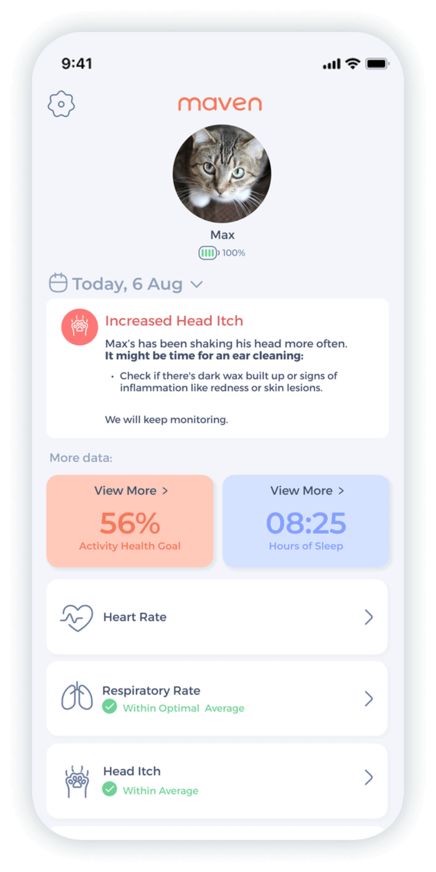
Monitor heart rate, respiratory rate, activity & rest, itch behavior.
The Maven Pet Health Monitor is designed to do exactly that:
- Tracks resting respiratory rate continuously, one of the earliest and most clinically meaningful indicators of developing cardiac issues in cats
- Monitors heart rate trends
- Measures activity and rest patterns, detecting reductions in movement or increases in rest that may reflect fatigue or discomfort
- Builds a personalized baseline for each cat, so deviations are flagged against what is normal for them — not a population average
- Sends alerts when deviations occur, such as a rising resting respiratory rate or a notable decline in daily activity
This continuous picture gives owners and vets something a clinic appointment alone cannot: a reliable window into how a cat is doing day to day, at home, at rest — precisely when early signs of heart disease are most likely to appear.
FAQ (Vet-Reviewed)
Heart disease in cats refers to conditions that affect the heart’s structure or function, reducing its ability to pump blood effectively. It can be present from birth or develop over a cat’s lifetime. The most common form is hypertrophic cardiomyopathy (HCM), where the heart muscle thickens progressively.
Common signs include an increased resting respiratory rate, labored or open-mouth breathing, reduced activity, withdrawal or hiding, appetite changes, and unexplained weight loss. In more advanced cases, sudden hind limb weakness or paralysis may occur. Many cats show no visible signs in the early stages of the disease.
Yes. HCM alone is considered one of the most frequently diagnosed cardiac conditions in cats, and it affects cats of all breeds and ages. Certain breeds — including Maine Coons, Ragdolls, and Sphynx — carry a higher genetic risk, but any cat can develop heart disease.
A resting respiratory rate consistently above 30 breaths per minute during sleep is a meaningful signal worth discussing with your vet. Open-mouth breathing at rest is always abnormal in cats and requires prompt attention. Any sustained change in your cat’s normal activity level or behavior — even gradual — is worth monitoring and mentioning to your veterinarian.
Conclusion
Heart disease in cats is common, often silent, and — when caught early — far more manageable than when it reaches an advanced stage. The challenge is that cats don’t make early detection easy. Their instinct is to mask vulnerability, and the disease itself often gives little away until it has progressed significantly.
That’s why what happens at home matters more than what happens at the clinic. Knowing your cat’s normal — their resting respiratory rate, their daily activity patterns, their typical behavior — is the foundation of early detection. And having a tool that tracks those patterns continuously, and alerts you when something shifts, is the closest thing we have to catching heart disease early.
Maven Pet focuses on improving the quality of life of our pets with technology, using artificial intelligence (AI) to enable proactive pet care. By accurately collecting and monitoring pet data 24/7 and flagging any irregularities, Maven Pet empowers pet parents and veterinarians to stay ahead of potential health issues, ensuring the well-being and longevity of our beloved companions.